


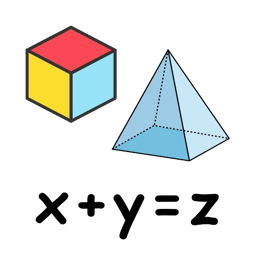
Three-Dimensional Shapes
Math ⇒ Geometry
Three-Dimensional Shapes starts at 6 and continues till grade 12.
QuestionsToday has an evolving set of questions to continuously challenge students so that their knowledge grows in Three-Dimensional Shapes.
How you perform is determined by your score and the time you take.
When you play a quiz, your answers are evaluated in concept instead of actual words and definitions used.
See sample questions for grade 7
A cone has a base radius of 4 cm and a height of 9 cm. What is its volume? (Use π = 3.14)
A rectangular box has length 8 cm, width 5 cm, and height 2 cm. What is its surface area?
A right circular cylinder has a height of 10 cm and a base radius of 3 cm. What is its volume? (Use π = 3.14)
A sphere has a radius of 7 cm. What is its volume? (Use π = 3.14. Give your answer to the nearest whole number.)
Calculate the surface area of a cube with edge length 5 cm.
How many edges does a pentagonal prism have?
How many faces does a cone have?
How many faces does a triangular prism have?
How many faces, edges, and vertices does a triangular pyramid have?
How many vertices does a rectangular prism have?
If a cube has an edge length of 4 cm, what is its volume?
If the length, width, and height of a rectangular prism are all equal, what shape does it become?
What is the name of a three-dimensional shape with two parallel circular bases connected by a curved surface?
What is the total number of edges in a cube?
Which formula is used to calculate the volume of a rectangular prism?
A right square pyramid has a base edge of 6 cm and a vertical height of 8 cm. Calculate its volume.
A solid has 8 faces, 12 edges, and 6 vertices. What is the name of this solid?
A solid object is made by joining a cube of side 3 cm and a cuboid of dimensions 3 cm × 3 cm × 5 cm along one face. What is the total volume of the object?
A triangular prism has a base area of 12 cm² and a height of 10 cm. What is its volume?
Describe the difference between a prism and a pyramid in terms of their faces and bases.
